A hot shower turning cold halfway through. The kitchen tap not getting warm enough when you’re doing dishes. If you have a tankless water heater, you probably expected endless hot water on demand. So, when your tankless water heater is not keeping up, it can be frustrating. Many homeowners face this problem, but the causes are not always obvious. Understanding why this happens and how to fix it can save you time, money, and discomfort.
Tankless water heaters are designed for efficiency and convenience. However, they rely on several factors to work correctly. This article explains, in simple terms, why your tankless water heater might not be keeping up. You’ll learn how these systems work, the most common problems, troubleshooting steps, and when you need a professional.
You’ll also find real-world examples, practical advice, and solutions you can use today.
How Tankless Water Heaters Work
To solve a problem, you need to know how things should work. Tankless water heaters are different from traditional tank-style heaters. Instead of storing a big supply of hot water, they heat water as you need it.
When you turn on a hot water tap, cold water enters the unit. A powerful heat exchanger quickly heats the water as it passes through. Gas or electricity provides the energy for this process. The hot water flows directly to your tap or shower—no waiting for a tank to refill.
This design means you should get hot water as long as you need it. But there’s a limit to how much hot water the unit can produce at once. If your demand is higher than the heater’s capacity, you might run into problems.
Key Factors Affecting Performance
- Flow rate: How much water you use at one time (gallons per minute, or GPM).
- Temperature rise: The difference between your incoming cold water and the desired hot water temperature.
- Power source: Gas units usually handle higher flow rates than electric models.
- Unit size: Undersized units can’t keep up if demand is too high.
Understanding these basics helps you find the real reason for performance issues.
Common Causes Of Tankless Water Heater Not Keeping Up
When your tankless water heater isn’t supplying enough hot water, there are several possible reasons. Some are simple, others more complex.
1. Undersized Water Heater
One of the most frequent causes is an undersized heater. If your tankless system was chosen without calculating your home’s hot water needs, it may not be able to keep up. For example, running a shower and dishwasher at the same time could exceed its flow rate.
How To Know
- Hot water cuts out when multiple fixtures are used.
- Water is warm, not hot, during peak times.
Example
A family with three showers and a large bathtub bought a small electric tankless unit. When two showers are in use, both get lukewarm water.
2. Cold Climate And High Temperature Rise
Tankless heaters must heat cold water to your preferred temperature. In cold climates, incoming water can be as low as 40°F. If you want a shower at 110°F, that’s a 70°F temperature rise. Some units cannot handle such a large temperature increase at high flow rates.
Signs
- Hot water is sufficient in summer, but struggles in winter.
- Water is only warm when using multiple taps.
3. Simultaneous Demand
Even the best tankless heaters have a limit. Running multiple showers, washing machines, and sinks at once may exceed the system’s maximum flow rate.
Symptoms
- Hot water cuts in and out when several taps are used.
- Only one fixture gets fully hot water at a time.
4. Incorrect Temperature Settings
Sometimes, the temperature setting on your tankless water heater is too low. If set below 120°F, water may feel only lukewarm.
Signs
- Water is consistently not hot enough, even with just one tap.
- Thermostat or remote shows a low set temperature.
5. Clogged Filters Or Heat Exchanger
Mineral buildup from hard water can clog the heat exchanger or filters. This reduces heating efficiency and can lower flow rates.
Clues
- Hot water starts strong, then cools quickly.
- Maintenance has not been performed in over a year.
6. Gas Supply Problems
For gas tankless heaters, insufficient gas flow can limit performance. Undersized gas lines, blocked vents, or low gas pressure can all cause trouble.
Warning Signs
- Water heater shuts off or gives error codes.
- Other gas appliances also perform poorly.
7. Electrical Issues (for Electric Units)
Electric tankless heaters need a lot of power. If the wiring or breakers cannot supply enough electricity, the heater will not work at full capacity.
Indicators
- Circuit breakers trip during hot water use.
- Water is only warm, not hot.
8. Malfunctioning Flow Sensor
The flow sensor detects when water moves through the unit. If it’s dirty or faulty, the heater may not turn on or heat water properly.
What To Look For
- Hot water works sometimes, but cuts out randomly.
- Error codes on the display.
9. Faulty Thermostat Or Temperature Sensor
If the sensor that measures water temperature is broken, the heater may not heat water correctly.
Signs
- Water temperature fluctuates wildly.
- Heater shows temperature errors.
10. Installation Errors
Improper installation is a common but overlooked issue. Examples include poor venting, wrong pipe sizes, or incorrect electrical connections.
Clues
- Problems started immediately after installation.
- Multiple error codes or warnings.
Diagnosing The Problem: Step-by-step
Before you call a plumber or buy a new unit, try these steps to narrow down the cause.
Step 1: Check The Demand
- Count how many fixtures you use at once.
- Add up the flow rates (GPM) for each. For example, a shower uses 2.0 GPM, a dishwasher 1.5 GPM, etc.
If your total exceeds the heater’s maximum flow rate, you’ll need to manage usage or upgrade your system.
Step 2: Inspect The Temperature Setting
- Find your heater’s control panel or remote.
- Set the temperature to 120°F–125°F for most uses.
- Wait a few minutes and test the water.
If the water is still not hot, the issue is likely elsewhere.
Step 3: Clean Filters And Descale
- Turn off power/gas and water supply.
- Remove and clean inlet filters as described in your manual.
- Run a descaling solution (like white vinegar) through the heater if you have hard water.
Regular cleaning can improve performance dramatically.
Step 4: Check For Error Codes
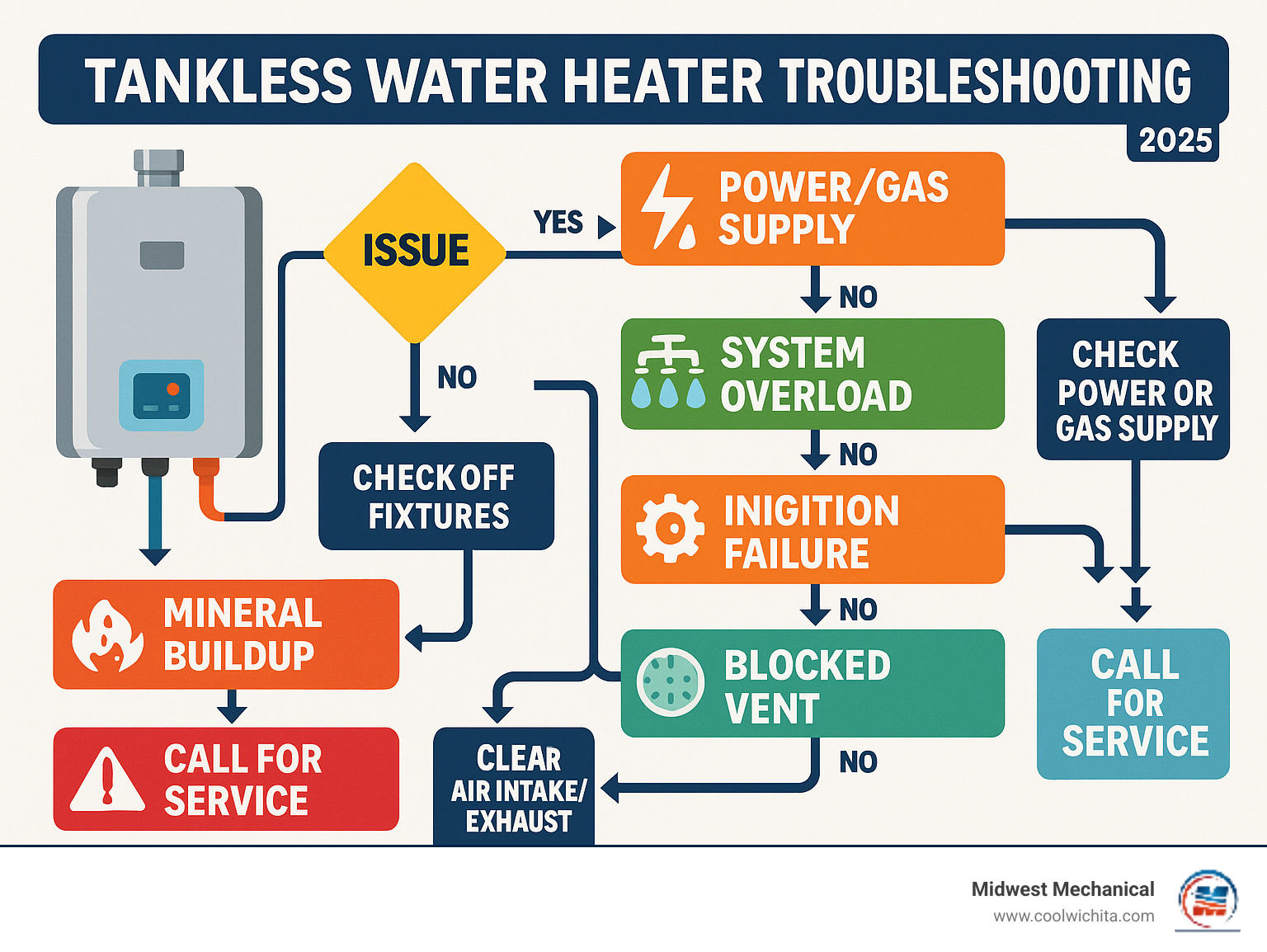
Most modern tankless heaters display error codes. Look for these on the digital panel, then check your manual for the meaning.
Step 5: Examine Power Or Gas Supply
- For electric units: Make sure breakers are on and wiring is intact.
- For gas units: Check that the gas valve is open and the supply is strong.
If other gas appliances are struggling, your supply line may be too small.
Step 6: Look For Installation Problems
- Check for obvious leaks or loose connections.
- Make sure the venting is clear (for gas models).
- Inspect wiring and circuit breakers (for electric models).
If you find installation errors, call a professional.
Comparing Tankless Vs. Traditional Water Heaters
To understand if a tankless system fits your needs, here’s a side-by-side look:
| Feature | Tankless Water Heater | Traditional Tank Heater |
|---|---|---|
| Hot Water Supply | Endless, but limited by flow rate | Limited by tank size (40–80 gallons typical) |
| Energy Efficiency | High (up to 34% more efficient) | Lower (standby heat loss) |
| Space Needed | Small wall-mounted unit | Large floor space required |
| Lifespan | 15–20 years | 10–15 years |
| Upfront Cost | Higher | Lower |
This table shows that tankless heaters offer many benefits, but only if sized and installed correctly.
Real-world Examples
Example 1: Family Of Four, Cold Winters
A family in Minnesota installed a gas tankless heater rated for 6.0 GPM at a 45°F temperature rise. In winter, their incoming water drops to 40°F. The heater can only provide 3.5 GPM at a 70°F temperature rise. When two showers run, one quickly turns cold. The solution: stagger showers or install a second unit.
Example 2: Small Apartment, Electric Unit
A single person in a warm state uses an electric tankless heater. When using the shower and kitchen sink together, water stays hot. But when a guest visits and both shower, water turns lukewarm. The unit is sized for one person, not two.
Example 3: Large Home, Multiple Bathrooms
A homeowner installs two smaller tankless units in parallel (a “cascade” system) to handle high demand. This setup allows several showers and appliances to run at once without loss of hot water.
How To Size A Tankless Water Heater Correctly
Choosing the right size is crucial. Here’s how to estimate what you need:
- List your fixtures: Showers, sinks, dishwashers, washing machines.
- Estimate flow rate: Find the GPM for each (look at fixture specs or use averages).
- Add up maximum demand: How many will run at the same time during busy periods?
- Calculate temperature rise: Find your winter groundwater temperature (maps available online), subtract from desired hot water temp (usually 120°F).
- Match with heater specs: Choose a unit that can handle your maximum GPM at your required temperature rise.
Example Sizing Calculation
- Shower: 2.0 GPM
- Kitchen sink: 1.5 GPM
- Washing machine: 2.0 GPM
- Total: 5.5 GPM
If your incoming water is 50°F and you want 120°F water, you need a unit that can provide 5. 5 GPM at a 70°F rise.
Credit: saudimadad.com
Practical Solutions For Tankless Water Heater Problems
If your tankless water heater is not keeping up, there are several ways to improve performance.
1. Stagger Hot Water Use
Avoid running showers, laundry, and dishwashers at the same time. Schedule hot water tasks to reduce demand on the system.
2. Lower The Set Temperature
By lowering the thermostat from 140°F to 120°F, you reduce the temperature rise needed. This lets the heater supply more hot water at a given time.
3. Install A Second Unit
Homes with high demand may need two tankless heaters, either in parallel or serving different parts of the house.
4. Descale And Maintain Regularly
Flush the unit with descaling solution at least once a year, especially in areas with hard water. Clean inlet filters every 6–12 months.
5. Upgrade Gas Or Electrical Supply
If your unit is starved for gas or electricity, have a professional inspect and upgrade supply lines or breakers.
6. Insulate Pipes
Pipe insulation reduces heat loss and helps hot water reach fixtures faster, especially in cold basements or crawl spaces.
7. Use Low-flow Fixtures
Switching to low-flow showerheads and faucets reduces GPM, making it easier for your heater to keep up.
8. Install A Recirculation Pump
Some tankless units can be paired with a recirculation pump, so hot water gets to fixtures faster, reducing “cold water sandwich” effects.
9. Fix Installation Errors
Hire a licensed plumber to inspect and correct any installation mistakes, especially for venting and gas/electric connections.
Common Myths About Tankless Water Heaters
Some misconceptions can lead to disappointment or misuse.
- Myth: Tankless heaters provide unlimited hot water for every fixture at once.
- Reality: There’s still a limit based on the unit’s flow rate and temperature rise.
- Myth: Any plumber can install a tankless heater.
- Reality: Proper installation requires special training and local code compliance.
- Myth: Maintenance is not needed.
- Reality: Annual descaling is crucial, especially in hard water areas.
Maintenance Checklist For Tankless Water Heaters
Regular maintenance keeps your heater running smoothly.
- Descale heat exchanger every 6–12 months.
- Clean inlet water filter every 6 months.
- Inspect venting for blockages or leaks.
- Check for error codes and fix issues promptly.
- Test water temperature at outlets.
- Look for leaks around the heater.
Following this checklist can prevent most performance problems.
Understanding Flow Rate And Temperature Rise
These two terms are often misunderstood, but they’re key to tankless performance.
| Region | Average Groundwater Temp (°F) | Max GPM at 70°F Rise | Max GPM at 50°F Rise |
|---|---|---|---|
| South Florida | 70 | 6.5 | 8.5 |
| Chicago | 47 | 3.8 | 5.3 |
| Seattle | 50 | 4.5 | 6.0 |
This shows why climate matters. In cold regions, a heater’s flow rate drops as it works harder to heat colder water.
When To Call A Professional
Some problems need expert help:
- You suspect gas or electrical issues.
- The unit shows repeated error codes you can’t resolve.
- Installation errors are present.
- The heater still doesn’t keep up after DIY steps.
A licensed plumber or HVAC technician can diagnose and fix complex problems safely.
How To Prevent Problems In The Future
Being proactive saves money and stress. Here’s what you can do:
- Size your unit correctly when buying.
- Keep up with yearly maintenance.
- Use water softeners in hard water areas.
- Educate family members about not overloading the system.
- Upgrade fixtures to low-flow models.
Taking these steps means fewer cold showers and more peace of mind.

Credit: www.youtube.com
Costs Involved In Upgrades And Fixes
It’s smart to understand the costs of improving your system.
| Upgrade/Fix | Typical Cost Range (USD) | Notes |
|---|---|---|
| Professional Descaling | $150 – $300 | Once per year recommended |
| Adding Second Heater | $1,200 – $3,000 | Depends on home size and installation |
| Upgrading Gas Line | $500 – $1,500 | For higher capacity units |
| Low-Flow Fixtures | $20 – $75 each | Easy DIY upgrade |
| Pipe Insulation | $50 – $200 | Saves energy, improves comfort |
Consider these investments if your current system isn’t meeting your needs.
Non-obvious Insights Most People Miss
- Altitude matters: Gas tankless heaters lose capacity at higher altitudes due to thinner air. This can reduce flow rates by 10–20%.
- Water pressure impacts performance: Low incoming water pressure can prevent the unit from activating or reaching full output.
- Recirculation system compatibility: Not all tankless heaters support recirculation pumps out of the box. Check your model’s specs before adding one.
Most homeowners focus only on unit size, missing these important factors.
:max_bytes(150000):strip_icc()/reasons-gas-water-heater-not-working-5212987-hero-fe6b82a59053421c88b7d13ea311d3c5.jpg)
Credit: www.thespruce.com
Useful Resources
If you want to learn more about tankless water heaters and how they work, check out this guide from the U.S. Department of Energy.
Frequently Asked Questions
Why Does My Tankless Water Heater Run Out Of Hot Water?
Most likely, your demand is higher than the heater’s flow rate allows. If you use too many fixtures at once, or if your unit is undersized, it can’t keep up. Mineral buildup, incorrect settings, or supply issues can also cause this problem.
Can A Tankless Water Heater Work For Large Families?
Yes, but only if sized correctly. Large families may need a high-capacity unit, multiple heaters in parallel, or careful scheduling of hot water use. Undersized units will struggle.
How Often Should I Maintain My Tankless Water Heater?
You should descale the heat exchanger and clean filters every 6–12 months. In hard water areas, maintenance should be more frequent. Check your manual for specific recommendations.
Why Is My Tankless Water Heater Hot Sometimes, Then Cold?
This usually happens when the unit’s flow sensor or temperature sensor is dirty or faulty, or if water flow drops below the minimum required to activate the heater. Descaling and cleaning can help.
Do Electric Tankless Water Heaters Have The Same Problems?
Electric models face similar issues with sizing and flow rate, but can also be limited by electrical capacity. Always check your home’s wiring and breaker sizes before upgrading or installing an electric unit.
A tankless water heater can deliver efficient, endless hot water—if it’s the right size and properly maintained. Understanding why your unit isn’t keeping up is the first step to a permanent fix. With the right information and a few smart changes, you can enjoy hot water whenever you need it, without surprises.