
Tankless Water Heater Wire Size: The Ultimate Guide
If you are planning to install a tankless water heater, one question will come up again and again: What wire size do I need? Choosing the right wire for your tankless water heater is not just about following rules—it’s about safety, efficiency, and saving money in the long run. Using the wrong wire size can lead to overheating, wasted energy, or even electrical fires.
Many homeowners believe that all water heaters use the same wiring, or that “bigger is always better. ” But the reality is more complex. Tankless water heaters have unique electrical needs, and choosing the correct wire size involves understanding amps, voltage, distance, and local codes.
This article will walk you through every factor you need to consider, with practical examples and clear explanations. You will also learn about the common mistakes people make, and how to avoid them.
By the end, you’ll know how to choose the best wire size for your specific tankless water heater, why it matters, and what to discuss with your electrician. Whether you are a DIY enthusiast or just want to understand what the pros are doing, this guide will make the process clear and simple.
What Is A Tankless Water Heater?
Tankless water heaters, sometimes called on-demand water heaters, heat water only when you need it. Instead of storing hot water in a large tank, they use powerful electric coils or gas burners to heat water as it flows through the unit. This means you never run out of hot water, and you save energy because you’re not constantly reheating a big tank.
There are two main types: electric tankless water heaters and gas tankless water heaters. This article will focus mainly on electric models, as wire size is a key issue for those. But many of the safety and sizing ideas apply to all types.
Why Wire Size Matters For Tankless Water Heaters
Choosing the right wire size is critical for several reasons:
- Safety: Undersized wires can overheat and cause fires.
- Efficiency: Correct wiring ensures the heater operates at peak performance.
- Longevity: Proper wire size prevents damage to both your heater and your home’s electrical system.
- Compliance: Electrical codes require certain wire sizes for specific loads.
A tankless water heater can draw a lot more power than a traditional tank heater. For example, a small tankless unit might need 60 amps or more, while a standard tank heater may use just 20-30 amps. That’s a big difference!
Key Factors That Determine Wire Size
Several factors affect the right wire size for your tankless water heater:
- Heater Power Rating (Amps)
- Voltage
- Wire Length (Distance from panel to heater)
- Wire Type (Copper or Aluminum)
- Local Electrical Codes
Let’s break each of these down.
1. Heater Power Rating (amps)
Every tankless water heater has a power rating. This is usually listed on the unit as “amperage” (amps) and sometimes as “kilowatts” (kW). The higher the amp rating, the larger the wire you need.
For example:
- A 24 kW electric heater at 240 volts draws 100 amps.
- A 15 kW unit at 240 volts draws about 62.5 amps.
2. Voltage
Most electric tankless water heaters in the US use 240 volts. Some smaller units use 120 volts, but these are less common for whole-house use. The voltage affects how much current (amps) the heater draws.
3. Wire Length
The longer the wire, the greater the voltage drop. If the wire is too long, the heater may not get enough voltage to work properly. In these cases, you may need to use a larger wire to make up for the lost voltage.
4. Wire Type
Copper wire carries current more efficiently than aluminum. Most homes use copper wiring, and all the examples in this article will assume copper unless stated otherwise.
5. Local Codes
The National Electrical Code (NEC) sets the minimum wire size for safety, but local codes can be stricter. Always check with your city’s building department before starting any installation.
How To Calculate The Correct Wire Size
Let’s look at the step-by-step process to choose the right wire size for your tankless water heater.
Step 1: Find The Heater’s Amp Rating
Look at the label on your tankless water heater or the manual. Find the maximum amperage (amps) or the kilowatt rating.
For example, if your heater is rated at 18 kW at 240 volts:
- Amps = kW × 1000 ÷ Volts
- Amps = 18,000 ÷ 240 = 75 amps
Step 2: Check The Wire Size Chart
Use the following table to match the amp rating to the correct wire size for copper wire (based on NEC 2023):
| Amps | Wire Size (AWG) | Common Usage |
|---|---|---|
| 15-20 | 12 | Small point-of-use heaters |
| 25-30 | 10 | Medium point-of-use heaters |
| 40-55 | 8 | Small whole-house or large point-of-use |
| 60-80 | 6 | Most whole-house heaters |
| 90-100 | 4 | Large whole-house heaters |
Step 3: Adjust For Distance
If the wire run is more than 100 feet, you may need to go up one wire size to prevent voltage drop. For example, if your heater needs 6 AWG wire for a 60 amp draw, but your panel is 120 feet away, use 4 AWG wire instead.
Step 4: Check Local Codes
Some cities or states require even larger wire sizes for certain appliances. Always check before buying materials.
Step 5: Confirm Breaker Size
Wire size must match the circuit breaker size. For example, 6 AWG wire can handle up to 65 amps, so it pairs with a 60 amp breaker.
Typical Wire Sizes For Tankless Water Heaters
Let’s look at some popular tankless water heater models and their wiring needs. This will help you see real-world examples.
| Heater Model | Max Amps | Wire Size (AWG) | Breaker Size (amps) |
|---|---|---|---|
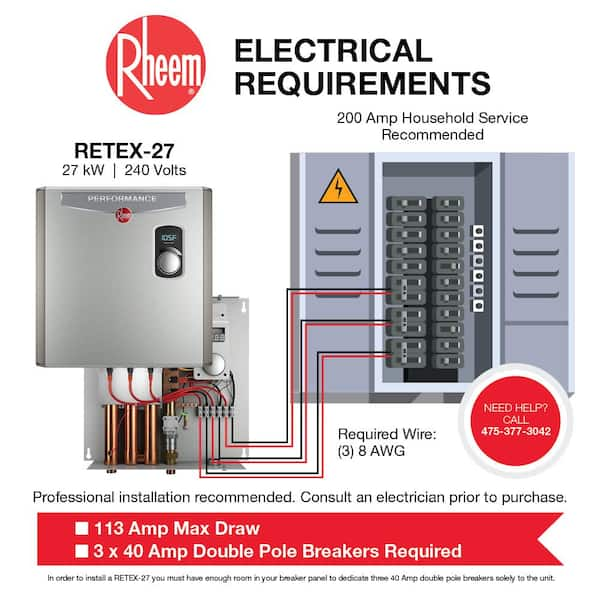
| EcoSmart ECO 27 | 112.5 | 3 x 8 AWG | 3 x 40 |
| Stiebel Eltron Tempra 24 Plus | 100 | 2 x 6 AWG | 2 x 50 |
| Rheem RTEX-24 | 100 | 3 x 8 AWG | 3 x 40 |
| EcoSmart ECO 11 | 54 | 6 AWG | 60 |
| Stiebel Eltron DHC 6-2 | 25 | 10 AWG | 30 |
Notice that some heaters need multiple wires and breakers. Always follow the manufacturer’s wiring diagram.
Common Mistakes When Choosing Wire Size
Many DIYers and even some pros make errors when wiring tankless water heaters. Here are the most common mistakes:
- Using wire that is too small. This can overheat and trip breakers or cause a fire.
- Ignoring voltage drop. Long runs of wire need larger sizes.
- Not checking the manual. Each heater is different—never guess.
- Mixing wire types. Do not mix copper and aluminum wire in the same circuit.
- Skipping local code checks. Local rules may be stricter than national codes.
- Assuming tank and tankless heaters use the same wiring. Tankless units usually require much heavier wiring.
Special Cases: Multiple Heating Elements
Some large whole-house tankless water heaters have multiple internal heating elements. This means they need more than one circuit, each with its own wire and breaker. For example, a unit may require “3 x 40 amp breakers and 3 x 8 AWG wires.” This setup is different from a single-circuit device, so always check the manual and wiring diagram.
Wire Size For 120v Vs 240v Tankless Heaters
Most whole-house tankless heaters use 240 volts, but some smaller units run on standard 120 volts. The wire size for these is usually smaller, but you still need to check the amp draw.
For example:
- A 120V, 20 amp heater needs 12 AWG wire.
- A 120V, 30 amp heater needs 10 AWG wire.
But remember, 120V units heat water much more slowly and are usually used only for a single sink or appliance.
How Wire Size Affects Performance
Picking the right wire size is not just a legal or safety issue—it affects how well your heater works.
- Undersized wire can make the heater run less efficiently, heat water more slowly, or shut down during heavy use.
- Oversized wire is not a problem for performance, but it costs more and is harder to install.
A non-obvious tip: For very cold climates or homes with high water demand, a larger wire can prevent nuisance tripping if your heater runs at full power for long periods.
Aluminum Wire: Should You Use It?
Aluminum wire is cheaper and lighter than copper but less common for water heaters. Aluminum has a higher resistance, so you must use a much larger wire size for the same amp load. Most professionals recommend copper wire for tankless water heaters due to its reliability and safety.
If you must use aluminum, check the NEC chart for aluminum wire ampacity, and always use approved connectors to prevent corrosion.

Credit: ghurairproperties.com
Grounding And Safety
A tankless water heater must be properly grounded. This means connecting a ground wire from the heater to your home’s electrical ground. Grounding helps prevent shocks and electrical fires.
- For a 60 amp circuit, use a minimum 10 AWG copper ground wire.
- For a 100 amp circuit, use an 8 AWG ground wire.
Never skip grounding—insurance companies and inspectors will check this point.
Upgrading Your Electrical Panel
Many older homes have a 100 amp main panel. A large tankless water heater can require 60, 80, or even 100 amps by itself. You may need to upgrade your main panel to a 200 amp service to handle the extra load.
This upgrade can be expensive, but it’s often necessary for safety. An electrician can do a “load calculation” to see if your current panel is large enough.
Understanding Breakers And Gfci Protection
The circuit breaker protects the wire and heater from overloads. Always use a breaker that matches the wire and heater size.
Some building codes require GFCI breakers for water heaters, especially in bathrooms or near water sources. GFCI (Ground Fault Circuit Interrupter) breakers add extra protection against electric shock.
Real-world Example: Sizing Wire For A Family Home
Let’s walk through a real-world scenario.
Imagine you have a family of four and choose a Stiebel Eltron Tempra 24 Plus. It’s rated at 100 amps at 240 volts and needs two separate 50 amp circuits.
- You check the manual: It recommends 2 x 6 AWG copper wire.
- The distance from your panel to the heater is 60 feet.
- Local code matches NEC.
- You install two 50 amp breakers, each with its own 6 AWG wire.
- You use an 8 AWG ground wire for each circuit.
If the panel were 120 feet away, you would upgrade to 4 AWG wire for each circuit to prevent voltage drop.
What Happens If You Use The Wrong Wire Size?
Choosing the wrong wire size can lead to several problems:
- Breaker tripping: The heater draws more current than the wire can handle.
- Overheating: The wire gets hot, which can damage insulation and cause a fire.
- Poor heater performance: The heater can shut off, heat water slowly, or display error codes.
- Failed inspections: The city may require you to redo the work, costing time and money.
- Voided warranty: Manufacturers often void warranties if installation does not meet code.
Cost Of Wiring For Tankless Water Heaters
Wiring is a significant part of the total installation cost. Here are some average prices:
- 6 AWG copper wire: $3–$5 per foot
- 4 AWG copper wire: $5–$7 per foot
- 50 amp breaker: $15–$35
- Electrician labor: $50–$100 per hour
If your heater is 50 feet from the panel, and you need two 6 AWG wires, you could spend $300–$500 just on wire. Planning ahead helps avoid surprises.

Credit: cinemaximiliaan.org
Wire Size Vs. Energy Efficiency
A less obvious point: Using the correct wire size improves your home’s overall energy efficiency. Undersized wires waste energy as heat. Over years of use, this can add up to higher electric bills. Proper wiring is an investment that pays back over time.
Tips For Diy Installers
If you are considering doing the wiring yourself, keep these points in mind:
- Get permits: Most cities require a permit for water heater wiring.
- Read the manual: Never skip the manufacturer’s instructions.
- Use the right tools: Heavy wire is hard to cut and bend.
- Label breakers: If you have multiple circuits, label everything for safety.
- Don’t guess: When in doubt, go one size larger or ask a pro.
A mistake many DIYers make is using leftover wire from another project—always buy new wire for high-power devices.
Credit: www.shakesandcones.com
Professional Vs. Diy Installation
While some handy homeowners can install a tankless water heater, most people should hire a licensed electrician. Tankless units draw a lot of power, and mistakes can be dangerous. An electrician will:
- Size the wire and breakers correctly
- Pull permits and schedule inspections
- Ensure grounding and code compliance
- Handle unexpected issues (old panels, aluminum wire, etc.)
If you do it yourself, you are responsible for any problems that arise.
How To Read A Wire Size Label
Wire is labeled by gauge (AWG) and by the number of conductors. For example, “6/2” means 6 gauge wire with two conductors plus a ground. “8/3” means 8 gauge wire with three conductors plus a ground.
For a heater that needs “2 x 6 AWG,” you need two separate 6 AWG wires, each with its own neutral and ground.
Upgrading Existing Wiring
If you are replacing a tank water heater with a tankless model, your existing wiring is probably too small. A tank heater might use 10 AWG wire, but most tankless units need 6 AWG or larger. Never try to “make do” with undersized wire.
Safety Inspections
After wiring your tankless water heater, always schedule an inspection. Inspectors will check:
- Wire gauge and length
- Breaker size
- Proper grounding
- Secure connections
- Clear labeling
Passing inspection is required for insurance and resale value.
When To Consider A Gas Tankless Water Heater
If your home cannot handle the electrical demands of a large tankless water heater, you may want to consider a gas model. These use less electricity, but you still need to wire the controls. Always consult a plumber or HVAC specialist for gas units.
Resources For Further Reading
For the latest electrical code, see the National Fire Protection Association.
Frequently Asked Questions
What Size Wire Do I Need For A 60 Amp Tankless Water Heater?
For a 60 amp tankless water heater, you should use 6 AWG copper wire for runs up to 100 feet. For longer runs, use 4 AWG. Always check your heater’s manual and local codes.
Can I Use 10 Awg Wire For A Tankless Water Heater?
10 AWG wire is only safe for heaters drawing 30 amps or less. Most whole-house tankless units need much larger wire—usually 6 AWG or 8 AWG. Using too small a wire is dangerous and against code.
Do I Need A Dedicated Circuit For My Tankless Water Heater?
Yes, all tankless water heaters require a dedicated circuit. This means the wire, breaker, and outlet are used only for the heater, with nothing else plugged in or wired to that circuit.
What Happens If My Wire Size Is Too Small?
If your wire is too small, it can overheat, trip the breaker, or even cause an electrical fire. The heater may also run poorly or shut off with error codes. Always use the correct wire size.
Can I Run My Tankless Water Heater On An Existing 100 Amp Panel?
Maybe, but it depends on your home’s total electrical load. Large tankless heaters can use 60–100 amps by themselves. You may need to upgrade to a 200 amp panel if your current panel is already close to its limit.
—
Getting the wire size right for your tankless water heater is not just a technical detail—it’s the foundation for safe, reliable hot water in your home. With the information in this guide, you can make smart decisions and avoid costly mistakes.
If you are ever unsure, don’t hesitate to call a licensed electrician. Your safety, comfort, and investment depend on it.