
As an Amazon Associate, we earn from qualifying purchases. This post contains affiliate links – if you buy through them, we may earn a commission at no extra cost to you.
Finding the best type of water heater to buy depends almost entirely on how your home handles energy and where you actually need the heat. The biggest mistake buyers make is ignoring their home’s existing infrastructure. You must match the heater’s power requirements to your current electrical panel or gas line. A unit that looks perfect on paper will fail if your wiring or plumbing can’t support it. The right choice offers enough flow for your daily habits without forcing you to upgrade your house’s internal systems.
1. 27kW Tankless Water Heater Electric

Best for: Large homes needing high-volume, simultaneous hot water output.
This heavy-duty unit is built to manage the demands of an entire house by providing up to 7.4 GPM. It relies on a 240V connection and requires specific electrical setups, including three 40A double-pole breakers and 8 AWG wires. If your electrical panel lacks this capacity, you can’t install this unit without professional upgrades.
Owning this means enjoying a constant temperature thanks to the smart heating matrix that adjusts in 1-degree increments. It eliminates the standby heat loss common in older tanks, which can significantly impact energy usage. This model isn’t for someone living in a smaller apartment or a home with limited electrical capacity, as the power requirements are quite strict.
Who it fits Large households that need to run multiple showers, a bathtub, and appliances at the same time. It suits those looking to reclaim closet space from a traditional bulky water tank.
Who should pass Anyone whose home electrical panel can’t support a 112.5A load. It’s also not suitable for homes that lack the required 240V wiring or the ability to run three separate 40A circuits.
2. Rheem RTG Series 8.4 GPM Natural Gas Tankless Water Heater

Best for: Large families wanting endless hot water via natural gas.
This non-condensing gas unit delivers 8.4 GPM, making it a powerful choice for homes with multiple bathrooms. Because it’s designed for outdoor installation, it removes the need for complex indoor venting systems. It uses 180,000 BTU/hr to ensure you never run out of water during high-demand periods.
Using this heater means shifting your maintenance focus to a gas-fed system rather than an electric one. The listing doesn’t mention efficiency or installation requirements. This isn’t for a home that lacks a natural gas supply or has strict local codes against outdoor water heater placement.
What goes smoothly:
- Provides high-flow output for 3-4 showers at once.
- Outdoor design saves significant indoor floor space.
- On-demand heating prevents energy waste from standby tanks.
- Durable metal cabinet stands up to outdoor elements.
What you have to accept:
- Requires a professional natural gas line connection.
- Can’t be installed indoors due to its design.
3. ThermoMate 2.5 Gallon

Best for: Quick hot water at single sinks or small spaces.
This mini-tank heater is a simple solution for locations far from your main water heater, like a garage, workshop, or kitchen sink. It plugs into a standard 120V outlet and holds 2.5 gallons of pre-heated water for instant access. The Incoloy 800 heating element is designed to resist corrosion better than standard copper elements.
In daily use, you’ll appreciate not having to wait for hot water to travel through your pipes. However, because it’s a tank, you’re limited to the 2.5-gallon capacity before the unit needs to recover. This isn’t for someone who needs to supply a full-sized shower or multiple high-flow appliances simultaneously.
Snapshot:
- Plugs into a standard 120V wall outlet.
- Compact size fits easily under most sinks.
- Adjustable temperature range up to 149°F.
- Fused porcelain enamel lining protects against rust.
- Includes a T&P valve for safety.
4. Rheem RTEX-06T

Best for: Single-point use where space is at a premium.
This point-of-use electric heater focuses on consistent performance for a specific location. It uses thermostatic control to keep water within 1 degree of your chosen temperature. Its small footprint allows it to fit in cabinets or tight areas where a traditional tank would never go.
Because this unit only heats water when you turn the tap on, it’s highly energy-efficient. It’s intended for specific, low-demand tasks rather than whole-house coverage. It isn’t for anyone expecting to heat water for an entire home, as its flow rate is limited by its 6.5kW power draw.
| What this one gives | What the buyer has to accept |
|---|---|
| Compact, space-saving design | Limited to point-of-use applications |
| Precise digital temperature control | Not for whole-house water needs |
| Energy-efficient on-demand heating | Requires 240V electrical connection |
5. Camplux 1.58GPM Tankless

Best for: Outdoor adventures, camping, and remote cabins.
This portable propane heater is built for mobility, featuring a handle and a lightweight body. It uses a 41,000 BTU burner to heat water on demand, making it perfect for outdoor showers or pet cleaning. It operates on low water pressure, which is a major advantage for remote setups using garden hoses or gravity-fed systems.
Owning this requires managing propane tanks, so you must always have fuel on hand. It’s strictly for outdoor use and must be kept dry and stored properly during winter. This isn’t for anyone looking for a permanent, automatic indoor heating solution, as it requires manual setup and fuel management.
What goes smoothly:
- Runs on low water pressure as low as 3 PSI.
- Includes a foldable handle for easy transport.
- Operates for over 15 hours on one 20 lbs propane tank.
- Dual-season mode adjusts for winter or summer weather.
What you have to accept:
- Requires manual setup and propane management.
- Must be kept dry and sheltered from rain.
6. 110V Tankless Water Heater Electric
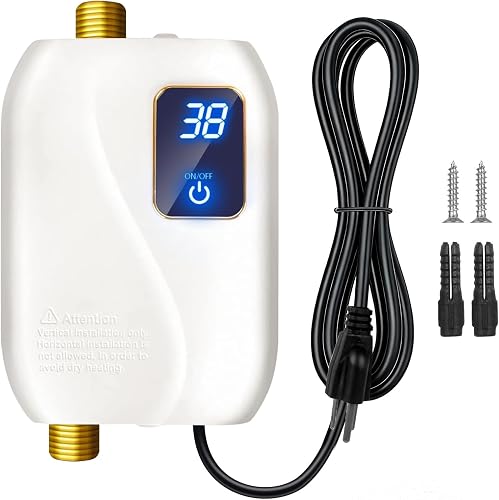
Best for: Small kitchens or bathrooms needing a simple electric boost.
This 110V unit is designed for under-sink installation to provide immediate hot water. It features a digital display to show working status and temperature. It’s built with stainless steel and ABS materials to withstand the environment under a sink.
The unit must be installed vertically to prevent heating element failure, which is a key requirement for its longevity. It’s efficient for light tasks but can’t keep up with high-flow needs like a full shower. This isn’t for anyone who needs to heat water for more than a single sink or low-flow bathroom fixture.
Snapshot:
- Digital display shows real-time temperature.
- Compact design fits under most standard sinks.
- IPX4 waterproof rating for safety.
- Easy installation with 1/2 inch NPT connections.
7. 2000W Immersion Water Heater with Digital Thermometer

Best for: Heating buckets, tubs, or pools manually.
This immersion heater is a raw-power tool for heating water directly in a container. It uses a 2000W element and a stainless steel guard to protect your tub or bucket from direct heat damage. It also comes with a digital thermometer to help you track the temperature.
You must be careful to keep the unit fully submerged while it’s plugged in, and you must unplug it before touching the water. It’s a manual tool, meaning you’re responsible for monitoring the process. This isn’t for someone who wants an automatic, “set-it-and-forget-it” plumbing solution.
| What this one gives | What the buyer has to accept |
|---|---|
| Fast heating for buckets or tubs | Must be manually submerged and unplugged |
| Built-in digital temperature monitoring | Not an automatic plumbing fixture |
| Stainless steel guard protects containers | Requires constant user supervision |
The Decision Filter
You must decide if you need a whole-house system or just a single-sink solution. Most people miss this: the electrical or gas capacity of your home is the primary constraint that limits your options. If you have a standard 120V outlet, you’re restricted to small point-of-use units. If you want whole-house heating, you must verify your panel or gas lines first. Ignoring these physical limits leads to failed installations. Always check your local building codes before choosing a gas or electric model.
The Thirty-Second Checklist
- Do you have an available 240V circuit for high-power electric models?
- Does your home have natural gas lines installed for gas-powered heaters?
- Will the unit be used for a single sink or the whole home?
- Do you have the necessary physical space under your sink or in your closet?
- Are you comfortable with the manual maintenance required for portable propane units?
- What happens if the heater fails; is there a backup or easy access for repair?
Three Regrets Worth Avoiding
Regret #1: Buying a high-flow electric tankless heater without checking if your home’s electrical panel has the necessary amperage. The fix is to have a licensed electrician verify your panel capacity before you place an order.
Regret #2: Expecting a point-of-use or under-sink heater to support a full-sized shower. These units are designed for sinks and low-flow applications; the fix is to check the GPM rating against the fixture you intend to use.
Regret #3: Installing a unit in a location that doesn’t allow for proper ventilation or drainage. The fix is to read the installation manual carefully for spacing and orientation requirements before you begin mounting the heater.
If You Want This, Look for That
| If you want… | Look for | Avoid |
|---|---|---|
| Whole house power | High GPM ratings | Low-amperage 110V units |
| Fast bucket heating | 2000W immersion power | Units without auto shut-off |
| Under-sink convenience | Compact dimensions | Units needing 240V if not available |
| Outdoor showers | Portable propane designs | Indoor-only gas models |
If two options look equal, choose the one with the best warranty coverage for your specific use case. After that, confirm your electrical or gas supply one last time before finalizing your purchase.
Frequently Asked Questions
Can I install a tankless water heater myself?
While some small point-of-use units are simple to install, most tankless heaters require professional plumbing and electrical or gas work. You should consult a qualified professional to ensure the installation complies with local safety codes and manufacturer requirements. Improper installation can void your warranty and create significant safety hazards for your household.
How do I know if my electrical panel can handle a new heater?
You must verify the specific amperage and voltage requirements listed by the manufacturer against your home’s current capacity. A professional electrician can perform a load calculation to see if your panel has the space for the required circuit breakers. Don’t guess; an overloaded panel is a major fire risk that requires expert attention.
What is the advantage of a tankless heater over a traditional tank?
Tankless heaters provide hot water on demand, which saves energy by not keeping a large volume of water hot 24/7. They also take up much less space, allowing you to reclaim room in your utility closet. However, you must ensure the unit’s flow rate matches your household’s peak demand to avoid running out of hot water.
How do I maintain my water heater to keep it running?
Maintenance depends on the type of heater, but most require annual flushing to remove scale buildup, especially in areas with hard water. Check the manufacturer’s manual for specific cleaning instructions and the recommended schedule for replacing anode rods. Keeping the unit clean and free of debris helps it maintain efficiency and extends its lifespan.
Are outdoor gas heaters safe for everyone?
Outdoor gas heaters are safe when installed according to the manufacturer’s instructions and local regulations. They must be placed in well-ventilated areas to prevent carbon monoxide buildup and kept away from flammable materials. Always ensure your setup includes a certified regulator and that you perform regular leak checks on all gas connections.
What should I do if my water heater stops working?
First, check the unit’s digital display or fault codes to see if it has triggered a safety shut-off. If the issue persists, review the troubleshooting section in your manual or contact the manufacturer’s technical support line. Don’t attempt to open or repair internal electrical or gas components yourself if you aren’t a trained professional.
Final Thoughts
Before you head to the store, take a quick look at your current setup to see what fits. It’s worth calling a local plumber to confirm your home’s capacity before you buy anything. You’ll save yourself a lot of trouble, and you won’t have to worry about unexpected installation costs later on.