
As an Amazon Associate, we earn from qualifying purchases. This post contains affiliate links – if you buy through them, we may earn a commission at no extra cost to you.
Finding the right water heater means balancing the capacity you need with the space you have. Most people focus on the flow rate, but the real secret to a satisfying setup is matching your home’s electrical or gas capacity to the unit’s power. If you choose a tankless model that demands more power than your panel can safely provide, you’ll face significant electrical upgrades. A proper selection keeps your hot water flowing without forcing you to rewire your entire home or settle for tepid showers.
1. APUS 27kW Electric Tankless Water Heater

Best for: Large households needing continuous flow for multiple simultaneous uses.
This tankless system is built for high demand, using intelligent self-modulating technology to match power output to your real-time water flow. The 1°F adjustment range on the digital display allows for precise control.
Owning this unit means you no longer wait for a storage tank to reheat, freeing up significant floor space in your utility room or basement. Because it requires a 240V installation with specific breaker and cable requirements, it’s best suited for those who already have or are planning a professional-grade electrical setup.
Who it fits: Large families who want to run multiple showers and laundry at once. Who should pass: Homes without the necessary 240V electrical capacity or space for 3x40A breakers.
2. Rheem RTG Series 8.4 GPM Natural Gas Tankless Water Heater

Best for: High-demand homes with natural gas access.
This unit provides an impressive 8.4 GPM, making it a heavy-duty solution for whole-house use. It’s designed specifically for outdoor installation, which removes the need for complex indoor venting and keeps your living space quiet.
The non-condensing technology is rated for high efficiency, using up to 34% less energy than 50-gallon electric tank heaters. However, because it relies on natural gas and outdoor mounting, it isn’t for the apartment dweller or anyone lacking a gas line.
What goes smoothly:
- Provides high GPM for 3-4 simultaneous showers.
- Outdoor installation saves indoor wall and floor space.
- Durable metal cabinet built for exterior weather.
- On-demand heating eliminates standby energy loss.
What you have to accept:
- Requires a natural gas connection.
- Outdoor-only mounting limits placement options.
3. GE Appliances 18 Gallon Versatile Electric Water Heater with Adjustable

Best for: Small households or single-person living spaces.
The GE 18 Gallon is a “lowboy” design, which means it fits in tight spaces where height is limited. Its 3.8kW element provides quick recovery, ensuring you have hot water ready shortly after a previous use.
This model is a straightforward replacement for existing tank installations. It isn’t designed for large families, as the 18-gallon capacity will run out quickly if multiple people are showering back-to-back.
Who it fits: One-to-two person households living in apartments or small homes. Who should pass: Large families who need endless hot water for multiple bathrooms.
4. Ecosmart ECO MINI 4 4-Gallon 120V Electric Mini Tank Water

Best for: Adding hot water to a specific, isolated point of use.
This 4-gallon mini tank is designed to sit under a sink and plugs into a standard 120V outlet. It’s an ideal buffer for sinks where you don’t want to wait for hot water to travel from a main heater.
Because it’s a small tank, it isn’t a replacement for your home’s primary water heating system. It’s strictly for point-of-use applications, meaning it won’t support a full shower or high-volume demand.
What goes smoothly:
- Simple plug-in installation for 120V outlets.
- Compact size fits easily under cabinets.
- Includes pressure relief valve for safety.
- Ideal for buffer or point-of-use needs.
What you have to accept:
- Very limited capacity; not for whole-home use.
- Recovery time is limited by the small tank volume.
5. 18kW Tankless Water Heater Electric

Best for: Small-to-medium homes wanting a space-saving, mid-range tankless option.
The NOVIEEX 18kW unit offers a 4.9 GPM flow rate, which is enough to handle a shower and a kitchen sink at the same time. It uses smart adaptive heating to keep the temperature stable.
Its compact wall-mount profile maximizes spatial efficiency in utility areas. If you don’t have the specific 240V electrical requirements, such as the 75A maximum current, this unit won’t work for your home.
Who it fits: Medium-sized homes or apartments looking for a space-efficient upgrade. Who should pass: Homeowners who can’t meet the specific 240V dual-breaker electrical requirements.
6. Rheem 8kW Multi Fixture Tankless Electric Water Heater

Best for: Multi-fixture applications in smaller living spaces.
This 8kW model is a compact way to get on-demand hot water without the bulk of a tank. It features thermostatic controls that adjust in 1-degree increments, allowing for consistent comfort.
However, its 1.95 GPM limit means it isn’t intended for high-demand, whole-home scenarios where many taps are used simultaneously.
What goes smoothly:
- Extremely compact footprint.
- Digital thermostatic controls for precise heat.
- Eliminates standby energy loss of tanks.
- 5-year leak and 1-year parts warranty.
What you have to accept:
- Flow rate is limited to 1.95 GPM.
- Requires professional electrical installation.
7. CAMPLUX 5L Portable Tankless Water Heater

Best for: Off-grid adventures and outdoor cleaning needs.
The Camplux 5L is a portable, propane-powered heater that weighs only 10 pounds. It’s built for the outdoors, making it perfect for camping, washing dogs, or cleaning muddy gear.
Because it runs on D-size batteries and requires low water pressure, it’s the definition of convenience for rural or remote setups. It isn’t for permanent indoor residential use and won’t supply a standard high-pressure home shower.
Snapshot:
- 1.32 GPM flow rate for instant heat.
- Runs on propane and D-cell batteries.
- Lightweight with a folding handle.
- Starts with as little as 3.0 PSI.
- Includes shower head and gas regulator.
8. 2.5 Gal Mini Tank

Best for: Quick hot water under a sink or in a small camper.
This mini tank heats water in 5-10 minutes and is designed to fit discreetly under a counter. It’s a great solution for handwashing or quick kitchen tasks where you want instant access to hot water.
The 304 stainless steel tank is built for durability, but it’s limited by its 2.5-gallon capacity. If you need hot water for a shower or a full bathtub, this unit won’t be enough.
Who it fits: Kitchens, bathrooms, or RVs needing a small, dedicated hot water supply. Who should pass: Anyone looking for a whole-house or multi-shower heating solution.
9. 110V Tankless Water Heater Electric
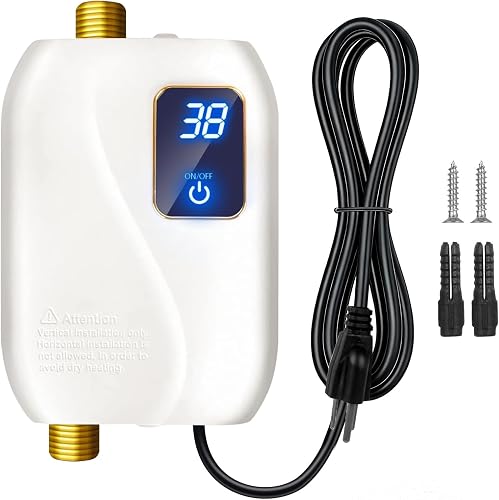
Best for: Point-of-use needs in apartments or bathrooms.
This 3000W unit is designed for 110V outlets and provides instant heat by eliminating the need to preheat water. Its compact size is perfect for tight spaces like apartment bathrooms or kitchen sinks.
It’s highly efficient for small tasks, but the listing specifically warns that it isn’t suitable for showers. If you try to use it for a high-flow shower, you’ll likely be disappointed by the lack of sustained volume.
What goes smoothly:
- Compact wall-mounted design.
- Works on standard 110V power.
- LED digital display for status monitoring.
- High thermal efficiency.
What you have to accept:
- Not for shower use.
- Requires vertical installation to function.
10. ThermoMate Electric Tank Water Heater

Best for: Versatile installation in tight utility or living areas.
The ThermoMate 8 Gallon offers a balance between a tank and a point-of-use heater. It can be mounted on the wall or the floor, providing flexibility for under-cabinet or basement placement.
The porcelain enamel glass lining and thick insulation are designed to keep water hot for longer, saving energy. It’s a robust choice for small applications, but it isn’t intended for whole-home use.
Who it fits: Garages, workshops, or small homes needing a dedicated hot water source. Who should pass: Those requiring a high-flow, whole-home heating solution.
The Decision Filter
To pick the right heater, start by identifying your primary goal: are you replacing a whole-home system or adding hot water to a single sink? Whole-home systems require high-voltage electrical or gas lines, while point-of-use models often work with standard outlets. Most people miss this: the flow rate (GPM) is only useful if your home’s plumbing and electrical supply can actually deliver that much power. If you have limited space, look for “lowboy” or compact tankless models. Always verify your breaker panel capacity before choosing an electric tankless unit. If you’re unsure about your home’s electrical layout, consult a professional electrician first.
The Thirty-Second Checklist
- Will this unit be the only source of hot water for your home?
- Does your current electrical panel have the required amps and breaker space?
- Is there a gas line available if you’re looking at a gas model?
- How many fixtures will be running at the exact same time?
- Is the installation area large enough for the unit’s physical dimensions?
- Do you have a professional installer lined up for the wiring or plumbing?
Three Regrets Worth Avoiding
Regret #1: Buying an electric tankless heater without checking your panel’s amperage. Many models require multiple high-amp breakers, and installing them without a panel upgrade is impossible. Always check the electrical specs in the listing against your home’s capacity.
Regret #2: Choosing a point-of-use model for a shower. Small tankless units often lack the flow rate required to keep a shower warm, leading to cold water mid-wash. Check the GPM requirements for showers before selecting a small unit.
Regret #3: Ignoring vertical installation requirements. Some tankless heaters must be mounted vertically to prevent damage to the heating elements. Read the installation notes in the listing carefully to ensure your space allows for the correct orientation.
If You Want This, Look for That
| If you want… | Look for | Avoid |
|---|---|---|
| Whole-home heat | High GPM rating | Low-amperage point-of-use units |
| Space savings | Tankless design | Large traditional storage tanks |
| Simple setup | Plug-in 120V models | Complex 240V wiring |
| Outdoor use | Propane/Gas models | Indoor-only electric units |
| Quick install | Standard NPT connections | Proprietary plumbing fittings |
For safe and reliable performance, ensure all electrical and plumbing work meets the Underwriters Laboratories safety standards for water heating equipment.
If two units seem identical, choose the one with the longer warranty on the tank or heating element. Check your local building codes today to see if you need a permit for your specific installation.
Frequently Asked Questions
Does this heater work with my existing plumbing?
Most models listed here use standard 1/2-inch or 3/4-inch NPT connections, which are compatible with typical residential plumbing. However, you should always measure your existing pipe diameter before purchase. If your pipes are non-standard, you may need an adapter to ensure a leak-free connection.
Can I install these units myself?
While some plug-in models are simple, most 240V tankless heaters require professional electrical installation to ensure safety and code compliance. Improper wiring can lead to performance issues or safety hazards. Always check the manual’s installation requirements against your own skills.
What happens if the power goes out?
Electric water heaters will stop heating immediately during a power outage. If you’re in an area with frequent outages, you might consider a gas-powered model, provided you have the proper venting and gas infrastructure. Tank models will retain heat for a limited time after a power loss.
How do I know if I have enough electrical power?
You must verify your home’s total amperage and available breaker space against the specific requirements listed for each heater. Most high-power tankless units require dedicated double-pole breakers. If your panel is full or lacks the necessary capacity, you’ll need an electrical service upgrade.
Is maintenance required for these heaters?
Yes, most tankless and tank models require periodic maintenance to prevent scale buildup and ensure longevity. This often includes flushing the system with vinegar or checking the anode rod in tank models. Regular upkeep prevents efficiency loss and keeps the heating elements working properly.
Can these be used in a mobile home or RV?
Many of the smaller tank or portable models are suitable for RVs, but you must check the voltage and power requirements. Never attempt to use a high-power residential heater in a vehicle unless the power system is specifically designed to handle the load. Always confirm the unit is rated for your specific environment.
Final Thoughts
Before you commit to a purchase, take a moment to look at your current utility connections. It’s worth calling a local plumber to confirm your home’s setup can handle the new unit’s requirements. They’ll help you avoid unexpected installation costs, ensuring you’re ready to enjoy that first hot shower in peace.