A tankless hot water heater is a modern solution for endless hot water in homes and businesses. Unlike traditional water heaters that keep a tank of water hot at all times, tankless heaters heat water only when you need it. This saves energy, space, and money. But what happens when your tankless hot water heater is not working? Suddenly, showers turn cold, dishes pile up, and daily routines are interrupted. If you’re facing this problem, you’re not alone. Many people experience issues with tankless heaters, from error codes to temperature drops.
This guide will help you understand why your tankless hot water heater isn’t working, how to fix common problems, and when to call a professional. You’ll learn how these heaters work, what signs to look for when they fail, and step-by-step solutions for getting your hot water back. Whether you’re a homeowner, renter, or property manager, this article offers clear advice, practical examples, and expert tips. Let’s explore the main causes and solutions for a tankless hot water heater that’s not working.
How Tankless Hot Water Heaters Work
To solve problems, it helps to know how tankless hot water heaters function. These units are also called on-demand water heaters. They use either gas or electricity to heat water as it flows through the unit. When you turn on a hot water tap, cold water enters the heater, passes through a heat exchanger, and comes out hot on the other side. Once you turn off the tap, the unit stops heating water.
Key components include:
- Heat exchanger: Transfers energy to the water
- Burner (gas models) or heating elements (electric models)
- Flow sensor: Detects when water is moving
- Control board: Runs the system and displays error codes
Unlike tank heaters, there is no storage of hot water. This means any problem with the heater instantly affects your hot water supply.
Common Symptoms Of A Failing Tankless Hot Water Heater
When a tankless water heater stops working, you might notice:
- No hot water at all
- Water is too hot or too cold
- Inconsistent temperatures
- Error codes on the display
- Low water pressure
- Unit shuts off during use
- Strange noises (clicking, rumbling, or banging)
- Water leaks near the unit
These symptoms can have simple or complex causes. Understanding what each sign means will help you troubleshoot faster.
Credit: saudimadad.com
Main Causes Of Tankless Hot Water Heater Problems
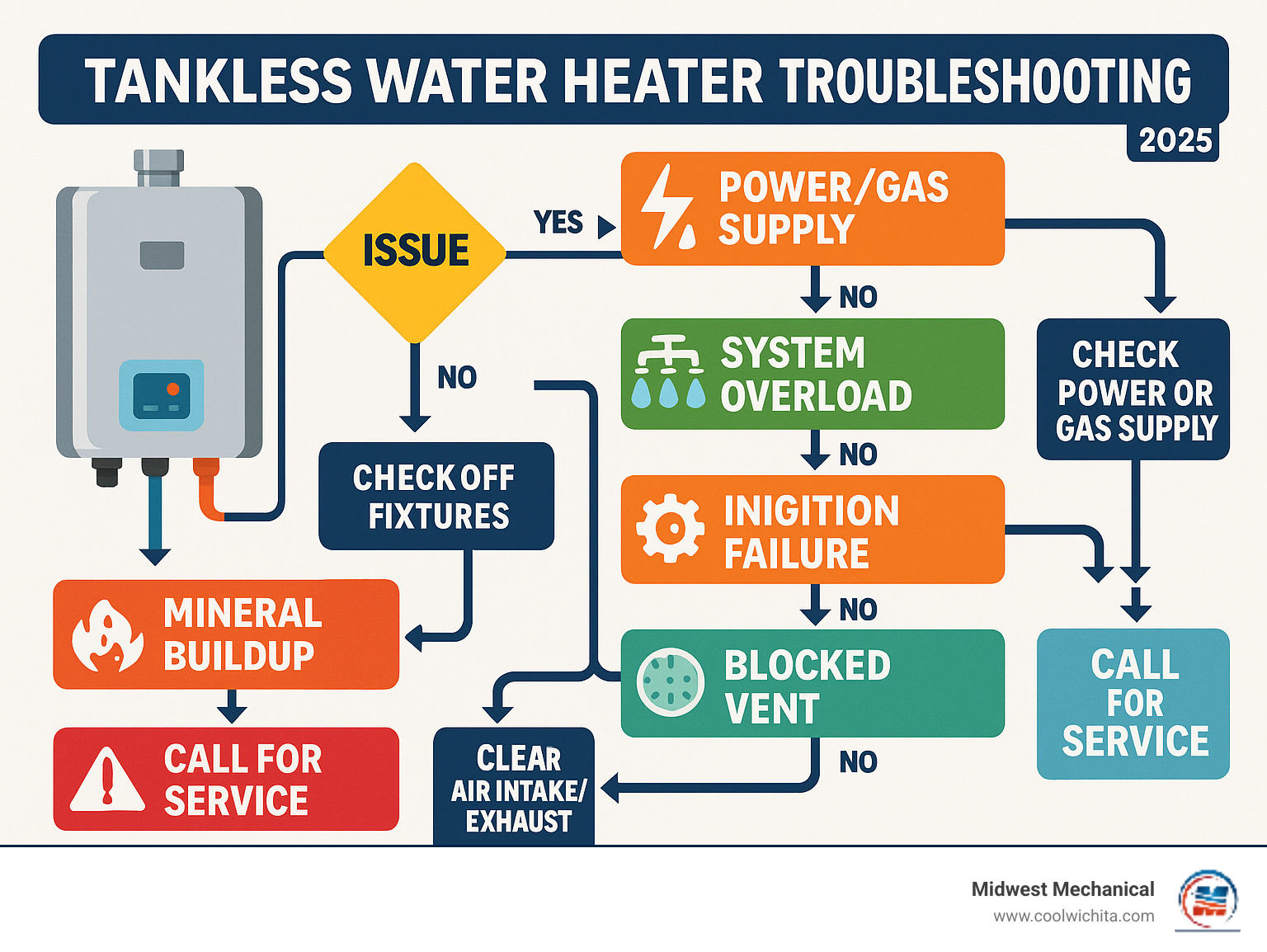
Tankless hot water heaters can stop working for several reasons. Here are the most common causes:
1. Lack Of Power Or Gas
Without power or gas, the heater cannot work. For electric models, this means checking the circuit breaker and power supply. For gas models, the gas valve might be closed, or the supply interrupted.
Quick checks:
- Make sure the unit is plugged in and switched on.
- Check the breaker panel for tripped switches.
- For gas units, ensure the main gas valve is open.
2. Overloaded System
Tankless heaters have a maximum flow rate (measured in gallons per minute or GPM). If too many taps or showers are running, the unit may shut down to prevent damage.
Signs of overload:
- Hot water cuts out when multiple taps run.
- Water temperature drops during use.
3. Blocked Air Or Water Filters
Tankless heaters have filters to keep debris out. If these become dirty, water flow and air intake are reduced, causing the unit to stop or show error codes.
Maintenance tip: Clean filters regularly according to the manual.
4. Mineral Buildup
Hard water contains minerals like calcium and magnesium. Over time, these can build up in the heat exchanger, reducing efficiency and causing overheating or shutdowns.
Prevention: Flush the unit with a descaling solution every 6-12 months.
5. Ignition Or Flame Failure
Gas units must ignite a burner to heat water. If ignition fails, you may see an error code or hear clicking sounds.
Possible causes:
- Low gas pressure
- Faulty igniter
- Blocked venting
6. Frozen Pipes
In cold climates, water inside or near the unit can freeze, blocking flow and damaging the heater.
Prevention: Insulate pipes and install a freeze protection kit if needed.
7. Sensor Or Control Board Failure
Modern heaters use sensors to monitor temperature, flow, and gas. If a sensor or the control board fails, the unit may shut down or behave erratically.
8. Poor Installation
Improper installation (wrong venting, gas line size, or electrical wiring) often leads to early failures or safety risks.
Always use a licensed professional for installation.
9. Venting Problems
Gas models need safe venting to remove exhaust gases. Blocked or poorly installed vents can cause shutdowns or dangerous leaks.
10. Water Supply Issues
Low incoming water pressure or closed shutoff valves can prevent the unit from working. Even municipal water supply issues can affect performance.
Tip: Check all shutoff valves and test water pressure if you suspect a supply problem.
Step-by-step Troubleshooting Guide
Now, let’s walk through practical steps to diagnose and fix a tankless hot water heater not working.
Step 1: Check Power And Gas Supply
- For electric units, ensure the unit is plugged in and the outlet has power.
- Check the breaker box for tripped switches.
- For gas units, confirm the main gas valve is open. If you smell gas, turn off the supply and call a professional immediately.
Step 2: Read The Error Code
Most modern tankless heaters have a digital display. If you see an error code, check your manual for its meaning. Common codes include:
- Error 11: Ignition failure
- Error 12: Flame loss
- Error 61: Fan failure
- Error 99: Improper venting detected
Step 3: Inspect Water And Air Filters
Turn off the unit and water supply. Remove the water filter and rinse it under running water. Clean or replace the air filter as needed.
Step 4: Flush The Heat Exchanger
Mineral buildup is a silent killer for tankless heaters. Flushing the system restores performance. Here’s a basic process:
- Turn off power and water supply.
- Attach hoses to the service valves.
- Pump white vinegar or a descaling solution through the unit for 45-60 minutes.
- Rinse with clean water before turning the unit back on.
Tip: Always follow the manufacturer’s instructions.
Step 5: Check For Frozen Pipes
Feel the pipes near the unit. If they are frozen, turn off the water supply and use a heat source (like a hair dryer) to thaw them gently. Do not use an open flame.
Step 6: Test Water Flow
Open a hot water tap and observe if the heater activates. If not, check if the flow sensor is stuck or dirty. Clean as recommended in the manual.
Step 7: Examine The Venting System
Look for obstructions or disconnections in the vent pipes. Make sure nothing blocks the air intake or exhaust.
Step 8: Reset The Unit
Many issues can be fixed by resetting the heater. Find the reset button (usually inside the front cover), press it, and wait a few minutes before trying again.
Step 9: Inspect For Leaks
Look for water around the unit or inside the cabinet. Leaks may indicate a cracked heat exchanger or loose fittings.
Step 10: Call A Professional
If you’ve tried all basic steps and the unit still doesn’t work, call a licensed plumber or technician. Some repairs require special tools or training.

Credit: www.youtube.com
Comparing Tankless And Tank Water Heater Troubleshooting
Understanding differences helps you choose the right approach. Here’s a side-by-side look:
| Feature | Tankless Water Heater | Tank Water Heater |
|---|---|---|
| Hot Water Supply | Endless, on demand | Limited to tank size |
| Common Failure | Ignition, flow, mineral buildup | Element failure, tank leaks |
| Maintenance | Regular flushing, filter cleaning | Occasional draining, anode replacement |
| Reset Method | Manual or auto reset button | Usually thermostat reset |
| Typical Lifespan | 15-20 years | 8-12 years |
Tankless heaters usually need more frequent maintenance but last longer. Troubleshooting is often more technical.
Error Codes: What They Mean And How To Fix
Most tankless heaters show codes to help you diagnose problems quickly. Here are some common ones:
| Error Code | Possible Cause | Suggested Fix |
|---|---|---|
| 11 | Ignition failure | Check gas supply, igniter, and venting |
| 12 | Flame loss | Check for drafts, gas pressure, and vent blockages |
| 14 | Overheat protection | Flush heat exchanger, check sensors |
| 29 | Condensate trap issue | Clean or replace trap |
| 61 | Fan failure | Clean fan, check wiring |
| 99 | Venting problem | Check vent pipes for blockage |
Always refer to your specific model’s manual, as codes can vary by brand.
Preventative Maintenance Tips
Regular maintenance keeps your tankless hot water heater running smoothly and prevents sudden failures.
- Descale the heat exchanger every 6-12 months, especially in areas with hard water.
- Clean water and air filters every 3-6 months.
- Inspect venting for blockages or leaks twice a year.
- Check for error codes regularly and address problems quickly.
- Schedule a professional inspection annually.
A small investment in maintenance can save hundreds on repairs and extend the life of your unit.
When To Repair, When To Replace
Sometimes, repair is not the best option. Consider replacing your tankless heater if:
- It’s more than 15 years old
- Repairs cost more than half the price of a new unit
- The same problem keeps coming back
- The heat exchanger is leaking
Newer models are more efficient and may qualify for rebates or tax credits.
Credit: www.wmhendersoninc.com
Cost Breakdown: Common Repairs And Replacement
Here’s a look at typical costs for tankless heater issues:
| Problem | DIY Cost | Professional Repair Cost | Replacement Cost |
|---|---|---|---|
| Flush/descale system | $20-$50 | $150-$250 | N/A |
| Replace igniter | $40-$100 | $150-$350 | N/A |
| Fix venting | $0-$50 | $100-$300 | N/A |
| Replace control board | $100-$200 | $300-$600 | N/A |
| Full unit replacement | N/A | $1,000-$2,500 | $1,000-$3,000 |
Non-obvious insight: Sometimes, a small part (like a sensor) can cause the unit to fail. Don’t immediately assume you need a new heater unless a qualified technician recommends it.
Special Considerations For Different Brands
Major brands like Rinnai, Navien, Noritz, and Rheem have unique features and common problems. Always consult the specific brand’s manual for troubleshooting. For example, Navien units are known for advanced error codes and built-in recirculation, while Rinnai heaters often display “LC” codes for scale buildup.
Some brands have dedicated support lines or online resources, which can speed up troubleshooting. If you have a warranty, check if repairs are covered before you pay for service.
What Homeowners Often Miss
Many people overlook these points:
- Minimum flow rate: If your faucet or shower is low-flow, the heater might not activate. Try opening another tap to test.
- Water temperature settings: If the thermostat is set too low, water may feel cold even if the unit is working. Check and adjust the set temperature.
- Error memory: Some heaters store error codes even after the problem is fixed. Resetting the unit can clear these and restore normal operation.
Common Mistakes To Avoid
- Ignoring maintenance: Skipping regular flushing and filter cleaning shortens the unit’s life.
- DIY repairs on gas units: Handling gas lines or venting without proper training is dangerous.
- Wrong size unit: Buying a heater too small for your home leads to constant shutdowns.
- Using harsh chemicals: Only use approved descaling solutions to avoid damaging the heat exchanger.
- Not checking water pressure: Low pressure can prevent the unit from activating.
When To Call A Professional
Some problems are best left to experts. Call a licensed plumber or technician if:
- You smell gas or see water leaks
- The unit trips breakers repeatedly
- Error codes persist after resets
- The heat exchanger leaks
- You are unsure about any repair step
Professional service ensures safety and keeps your warranty valid.
Where To Find Reliable Help
Manufacturer websites often offer troubleshooting guides, manuals, and support contacts. For official repair and warranty service, visit your brand’s website or check with the Plumbing-Heating-Cooling Contractors Association. Online forums can be helpful but always confirm advice with official sources.
If you’re interested in more details about how tankless heaters work, you can read this Wikipedia article.
Frequently Asked Questions
Why Does My Tankless Hot Water Heater Go Cold During Showers?
Most likely, the unit is overloaded (too many taps on at once) or there’s a maintenance issue like scale buildup. It can also happen if the minimum flow rate isn’t reached.
What Does It Mean If My Heater Shows An Error Code?
Error codes point to a specific problem. Check your manual for the code meaning. Common codes include ignition failure, venting issues, or overheat protection.
How Often Should I Flush My Tankless Water Heater?
Flushing every 6-12 months is best, especially in hard water areas. This removes mineral buildup and keeps the heat exchanger working well.
Can I Repair My Tankless Heater Myself?
You can do basic tasks like cleaning filters or flushing the unit. Gas or electrical repairs should be done by a professional for safety.
What Size Tankless Water Heater Do I Need?
Choose a unit that matches your household’s peak hot water demand (GPM). A professional can help you calculate the right size based on your needs.
Final Thoughts
A tankless hot water heater not working can disrupt your home, but most problems have clear solutions. By understanding how your heater works, recognizing early warning signs, and following practical troubleshooting steps, you can solve many issues yourself. Preventative maintenance is key to long-lasting performance. When in doubt, or when dealing with gas and electrical systems, don’t hesitate to call a professional. With the right care, your tankless water heater will deliver reliable hot water for years to come.